Quick answer
MIL-STD-461 is the United States Department of Defense standard for EMC requirements on military and dual-use equipment, including heavy-duty platforms. The current revision is MIL-STD-461G (2015). It defines a suite of conducted and radiated emission and susceptibility tests (CE101, CE102, CS101, CS114, CS115, CS116, RE101, RE102, RS101, RS103) with limits and methods that differ from automotive standards such as CISPR 25 and ECE R10. Heavy-duty zero-emission platforms targeted at defense or dual-use applications usually have to pass MIL-STD-461 in parallel with civilian EMC standards. The integration challenge is real: limits are stricter at certain frequencies, fixtures are different, and immunity test severities exceed automotive practice.
This article explains what MIL-STD-461 actually requires, where it diverges from automotive EMC, and how a heavy-duty integration program runs the two tracks in parallel without doubling the test burden.
What MIL-STD-461 covers
MIL-STD-461 is the joint-service military standard for the electromagnetic emission and susceptibility characteristics of equipment installed on military platforms. It has been revised six times since 1968 (A through G), with G being the current version since 2015. Its companion document, MIL-STD-464, covers system-level EMC including platform integration; in practice MIL-STD-461 governs equipment-level tests and 464 governs platform tests.
The standard structures EMC into four categories crossed with two test types:
- Conducted Emissions (CE): noise the equipment puts onto its power and signal lines. Tests CE101 (low-frequency power), CE102 (RF on power lines), CE106 (antenna terminals).
- Conducted Susceptibility (CS): immunity to noise injected onto power and signal lines. Tests CS101 (LF power), CS114 (bulk current injection), CS115 (impulse), CS116 (damped sinusoid), CS117 (lightning indirect effects), CS118 (personnel-borne ESD).
- Radiated Emissions (RE): RF the equipment radiates into space. Tests RE101 (magnetic field), RE102 (electric field, 10 kHz to 18 GHz, the dominant test).
- Radiated Susceptibility (RS): immunity to RF fields. Tests RS101 (magnetic field), RS103 (electric field, 2 MHz to 40 GHz), RS105 (transient EM field).
Each test has a procurement limit set by the requiring activity, often an OEM or defense customer specification, that selects from MIL-STD-461 limit curves. Limits depend on platform type: surface ship, submarine, aircraft (Army, Navy, Air Force), and ground vehicles each have different curves. Heavy-duty ground vehicles usually fall under the Army or Marine Corps ground-vehicle limit set.
How MIL-STD-461 differs from CISPR 25 and ECE R10
Engineers familiar with civilian automotive EMC make a recurring mistake: they assume MIL-STD-461 is a stricter version of CISPR 25 with the same fixtures. The two standards share physics but diverge on almost every practical dimension.
| Dimension | CISPR 25 / ECE R10 | MIL-STD-461G |
|---|---|---|
| Authority | IEC / UNECE (civilian) | US DoD (military, often referenced by NATO and dual-use programs) |
| Frequency range (radiated emissions) | 150 kHz to 2.5 GHz | 10 kHz to 18 GHz |
| Antenna distance | 1 m typical | 1 m typical, but with calibrated chamber correction |
| Conducted emissions on power lines | CISPR 25 LISN, 50 ohm / 5 microhenry | 10 microfarad LISN at low frequency, different impedance |
| Bulk Current Injection | ISO 11452-4, severities to 100 mA | CS114 with severities up to 200 mA (Class 1) or higher |
| RF immunity field strength | Up to ~100 V/m for vehicle-level | Up to 200 V/m (RS103, ground vehicles) |
| EUT setup | Vehicle-level or representative bench | Component on metallic ground plane, 5 cm raised |
| Pass criteria | Pass the limit at every frequency | Pass the limit at every frequency, with documented operating mode evidence |
The 18 GHz upper bound on RE102 is the most consequential single difference. Civilian automotive EMC stops at 2.5 GHz. MIL-STD-461 forces measurement of switching harmonics, harness re-radiation, and DC-DC noise components that are simply invisible in an automotive program. SiC-based traction inverters, with switching edges below a nanosecond, have spectral content well into the GHz range. Programs that pass ECE R10 cleanly often light up MIL-STD-461 RE102 at 4-12 GHz on the same hardware.
What changes for zero-emission heavy-duty platforms
MIL-STD-461 was written and revised over decades dominated by diesel and turbine military platforms. The transition to electric and hydrogen heavy-duty creates three integration challenges that the standard itself does not specifically address but that fall squarely within its measurement framework.
1. High-voltage switching at higher frequencies
A 600 kW SiC traction inverter switches at 30-50 kHz with edge rates that produce harmonics into the gigahertz range. CE102 limits on the HV bus capture this. RE102 captures the radiated component. Both tests can fail at frequencies a diesel platform never produced energy in, so component-level pre-compliance work has to be planned for the full 10 kHz to 18 GHz range.
2. Mode coverage during charging
Defense procurement frequently requires evidence that the platform is EMC-compliant in every operating mode, not only driving. For zero-emission platforms that means MIL-STD-461 testing has to cover the charging mode as well. This is conceptually similar to ECE R10 Series 06 charging-mode testing, but the procurement specification often requires both standards in both modes, doubling the chamber time.
3. RS103 immunity at high field strength
RS103 ground-vehicle limits can run to 200 V/m, far above civilian automotive immunity testing. This exposes susceptibility patterns in high-voltage isolation monitoring, BMS state machines, and torque-control loops that a civilian program would never see. Failure modes here are not catastrophic but they are persistent: a torque-control loop that drops by 5% under exposure is a documented immunity failure.
Running both tracks: dual-use program structure
The efficient approach is not to test twice. It is to design the EMC program from architecture review onwards with both standards in scope. The work that diverges late is mostly chamber time and fixture changes. The work that converges early is component selection, harness design, grounding strategy, and filter architecture. Programs that scope both standards from day one usually pass both with one redesign cycle. Programs that bolt MIL-STD-461 onto a finished R10 design often need three.
A practical staging looks like this:
- Architecture review (month 0-2): identify components and interfaces that hit both R10 and MIL-STD-461 limits. Apply the stricter envelope at design time.
- Pre-compliance on HV subsystems (month 3-6): CE101/CE102 conducted emissions on the HV bus, near-field surveys on the inverter, OBC and BMS. Many issues are caught here.
- Component-level MIL-STD-461 (month 6-9): RE102 and CS114 on the worst-case subsystems. Identify residual filter needs.
- Vehicle-level R10 (month 9-12): EU type-approval test sequence, charging and driving modes.
- Vehicle-level MIL-STD-461 / 464 platform tests (month 12-14): integration-level radiated and immunity tests, in a chamber sized for the full vehicle.
Why integration campuses matter for MIL-STD-461 work
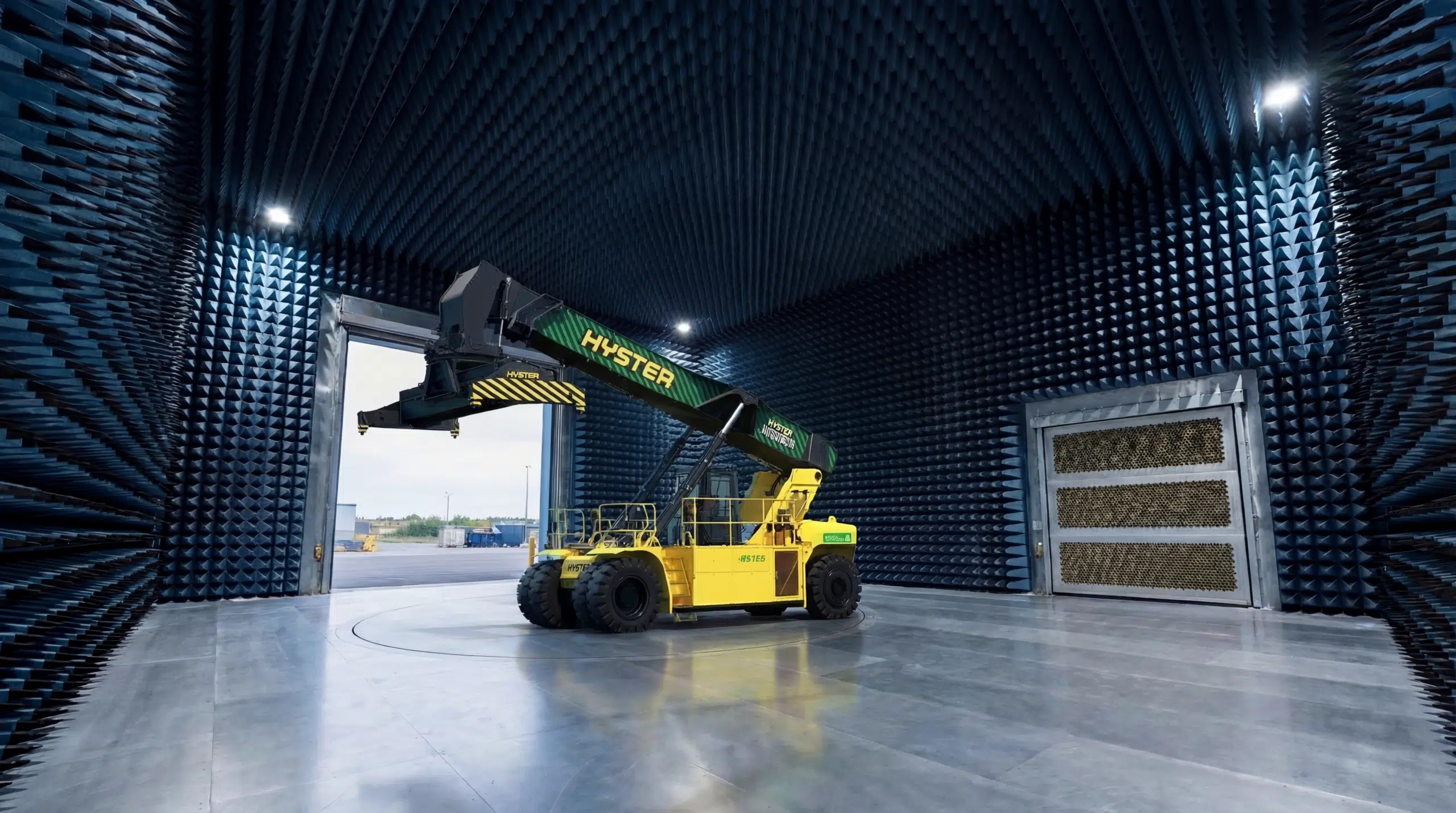
MIL-STD-461 chambers tend to belong to defense primes or defense-qualified test labs. They are sized for a missile, an avionics LRU, a comms chassis. Few are sized for a 12-meter zero-emission heavy-duty truck or a 60-tonne off-highway machine. A campus with a large-scale EMC chamber that can run both ECE R10 and MIL-STD-461 limits, on the same vehicle, in driving and charging mode, is a relatively rare configuration worldwide. That capability is what unlocks dual-use programs without forcing OEMs to ship the vehicle to two different sites in two different countries.
Procurement specifications: where the limits actually come from
MIL-STD-461 limits are not absolute. They are pulled by a procurement specification that selects from the standard’s limit curves. The same vehicle can be subject to different MIL-STD-461 limit selections by US Army TARDEC, US Marine Corps, NATO partners, and homeland-security customers. The OEM does not write the limit; the customer does. The integration partner reads the customer’s spec, maps it to MIL-STD-461 test IDs, and runs the right subset.
For dual-use heavy-duty platforms where the same vehicle serves civilian and defense customers, the strategy is to design to the strictest envelope of the relevant procurement specs, then qualify against each customer specification individually. This is the same pattern automotive Tier 1s use for multi-OEM programs, applied to defense.
Frequently asked questions
What is the difference between MIL-STD-461 and MIL-STD-464?
MIL-STD-461 governs EMC at the equipment level: emissions and susceptibility of individual subsystems on a defined test setup. MIL-STD-464 governs EMC at the platform level: total system electromagnetic environmental effects on the integrated vehicle, ship or aircraft. Heavy-duty zero-emission programs usually run MIL-STD-461 on subsystems and MIL-STD-464 on the integrated vehicle.
Does MIL-STD-461 apply outside the United States?
It is a US Department of Defense standard, but it is widely referenced by NATO partners, by allied procurement programs, by homeland-security customers, and by dual-use commercial-defense vehicle programs across Europe and Asia. Many European defense procurement specifications explicitly call out MIL-STD-461G as the applicable EMC standard.
Can a vehicle that passes ECE R10 fail MIL-STD-461?
Yes, and it is common. ECE R10 stops at 2.5 GHz in radiated emissions; MIL-STD-461 RE102 covers up to 18 GHz. SiC inverters and high-frequency DC-DC converters often produce radiated emissions in the 4-12 GHz range that no automotive test would catch. Likewise, RS103 immunity at 200 V/m exceeds anything in civilian automotive testing.
How long does MIL-STD-461 testing take for a heavy-duty vehicle?
A full equipment-level test sequence (CE101, CE102, CS101, CS114, CS115, CS116, RE101, RE102, RS101, RS103) on a major HV subsystem typically runs 5-10 working days per subsystem in chamber. A platform-level MIL-STD-464 test on an integrated heavy-duty vehicle is usually 5-15 working days, depending on the procurement specification.
Scoping a dual-use heavy-duty program?
IntegratR’s EMC chamber can run both ECE R10 / CISPR 25 and MIL-STD-461 / 464 limits on full heavy-duty vehicles, in driving and charging modes. Talk to our integration team about your procurement specification.
 English
  Dutch
Dutch